
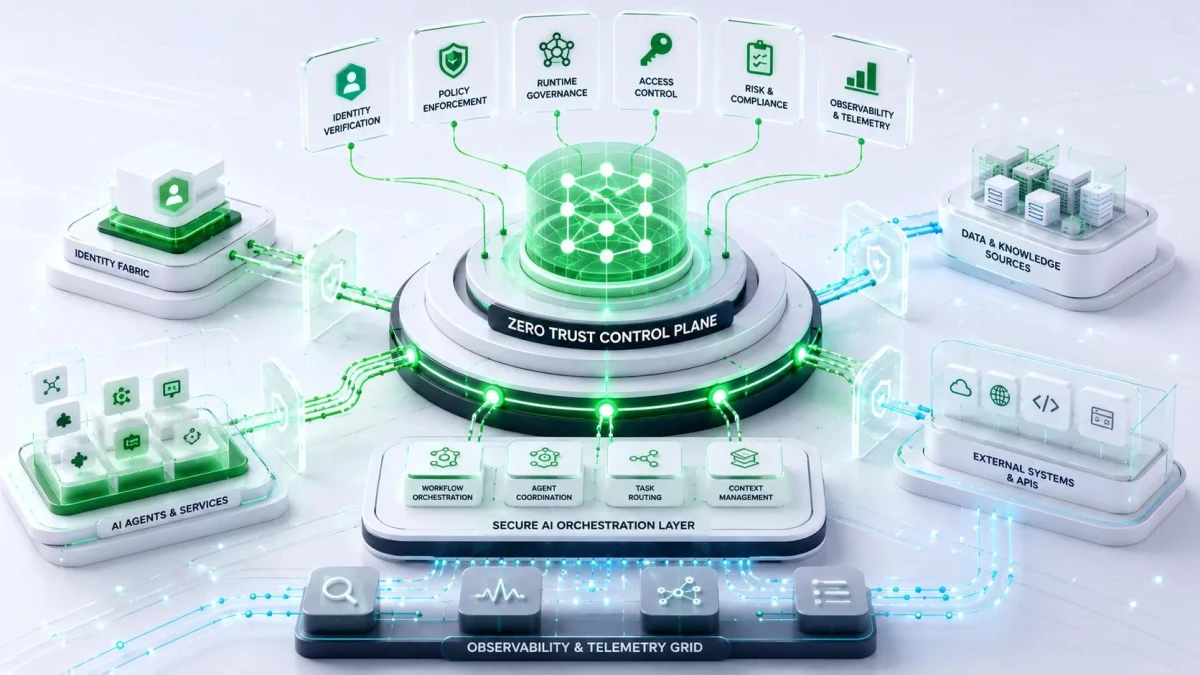
Zero Trust for AI agents is becoming a security standard for automated systems. Learn the core principles, the NIST and OWASP frameworks, and how companies can put them into practice.
Zero Trust for AI agents is a hot topic among cybersecurity practitioners right now. The concept is simple: every agent is treated as untrusted until proven legitimate. An agent must authenticate on every request, receive the minimum permissions needed for each resource, and have all of its actions logged for auditing.
AI agents work differently from ordinary chatbots. They call tools, read data, and take action on their own. They can also reason, spawn sub-agents, and act at machine speed. Older security models that rely on network boundaries are not enough for this kind of behavior.
Figures from the field show where the gaps are. The 2026 Cybersecurity Insiders report found that 56% of organizations are already exposed to agentic AI. Another 32% of organizations have no visibility into what their agents do, and 36% cannot see machine-to-machine AI traffic.
Security Risks in Automated Systems
The biggest risk comes from overly broad access rights. The same report says agents can take high-impact actions that are hard to reverse in collaboration, communication, and code systems. A single misdirected agent could delete data or send messages to thousands of people.
OWASP has already responded to the problem. In 2025, the OWASP GenAI Security Project released the Top 10 for Agentic Applications, with input from more than 100 industry experts. The list covers risks such as agent hijacking, tool misuse, and privilege abuse.
Keren Katz, one of the project’s leads, gave a clear warning. In her view, many companies are already exposed to attacks on agentic AI without realizing that agents are running in their environments. Some analysts also argue that older identity protocols such as OAuth 2.0 are no longer adequate for agentic systems.
Frameworks in Use Today
The technical foundation comes from NIST SP 800-207. NIST defines zero trust as a concept for granting access per request with least privilege, in a system where the network is assumed to be already compromised. Its scope also covers non-human identities, credentials, and infrastructure.
Major vendors are starting to turn the standard into products. In March 2026, Microsoft introduced Zero Trust for AI, which covers the entire AI lifecycle, from data to agent behavior. According to emergent.sh, Microsoft launched agent security controls on October 19, 2026, with agents starting out with no access at all.
The Cloud Security Alliance (CSA) offers a governance approach. The CSA Agentic Trust Framework, published in February 2026, applies zero trust specifically to agents. It groups agents by privilege level, from low-risk “intern” agents to “principal” agents with deep system access.
The four core principles remain the same: verify explicitly, use least privilege, assume breach, and continuously validate trust.
Steps to Implement Zero Trust for AI Agents
Start with identity. Okta recommends that companies treat agents as first-class identities, with zero trust controls, fine-grained authorization, and auditing just like human users. Without a clear identity, no one can be held accountable for an agent’s actions.