
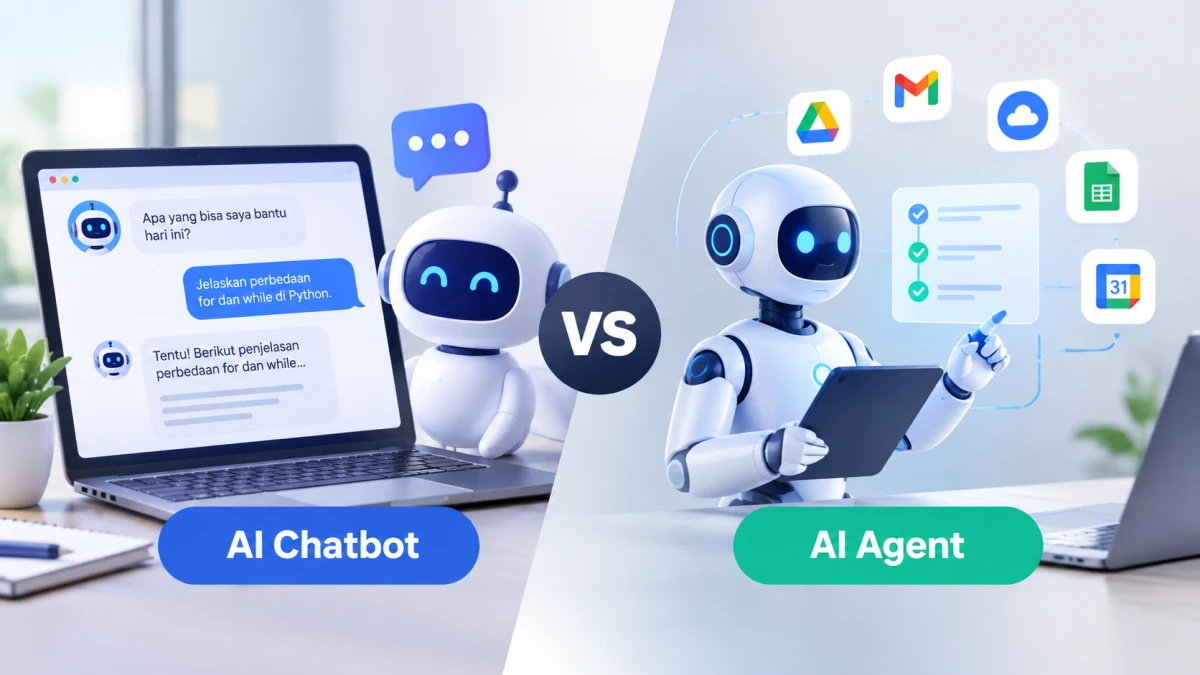
AI chatbots and AI agents differ in how they work and what they are for. Chatbots answer questions in conversation, while agents carry out multistep tasks on their own.
The difference between AI chatbots and AI agents confuses many people. Both rely on similar technology: Large Language Models (LLMs) and Natural Language Processing (NLP). But they work differently and serve different purposes.
An AI chatbot helps users through text or voice conversation. It answers questions, explains concepts, and offers ideas. An AI agent works toward a specific goal. It plans steps, uses other applications, and then evaluates the results.
Which one you choose depends on how complex your needs are. An AI agent is not always better than a chatbot. Building one requires decisions about system architecture, access limits, data security, and human oversight.
What Are AI Chatbots and AI Agents?
A chatbot can run on predefined rules (rule-based). It can also use more advanced NLP and LLMs. Its interaction centers on questions and answers or direct instructions from the user.
Take a student learning Python. The student asks about the difference between for and while loops, with examples. The chatbot then explains the theory, the syntax, and sample code. Companies also use chatbots widely for customer service, learning assistants, and information search.
An AI agent is a system that pursues an end goal. It plans and carries out a series of actions on its own or semi-autonomously. Agents connect to external data sources and third-party applications through Application Programming Interfaces (APIs). After receiving an initial instruction, the agent breaks it into subtasks and decides on the next step based on intermediate results.
Consider writing a progress report on the Internet of Things (IoT). The agent searches for references, groups the information by topic, and drafts the report in the requested format. It then saves the result through a connected application, within its access permissions.
Differences Between AI Chatbots and AI Agents
The main difference is the ability to manage goals, decide on steps, and act independently. A conversational interface is not what sets them apart. The table below summarizes the differences.
| Aspect | AI Chatbot | AI Agent |
|---|---|---|
| Focus | Communication and responses to questions | Achieving a goal by carrying out actions |
| How it works | Answers and follows direct instructions | Plans, sequences, and carries out multiple steps |
| User involvement | High, at every stage of the conversation | Lower, with oversight at certain points |
| Use of tools | Limited to built-in features | Broadly connected to external applications and APIs |
| Example output | An explanation of a concept or a short text summary | Data collection, analysis, and a final report |
The line between the two is not absolute. Modern chatbots often come with code execution or web search. As a result, a single application can be a chatbot and also have agentic capabilities.
Use a chatbot for simple, quick tasks, such as a light consultation, initial ideas, or an explanation of a concept. Choose an AI agent when the work goes through sequential stages and involves many applications. Agents also suit work that requires decisions based on intermediate results.
How AI Agents Work and Where They Are Used
An AI agent completes a task in five stages:
- Understanding the goal: The agent receives the main instruction describing the desired end result.
- Deciding on steps: The agent breaks the goal into operational actions, such as searching for information or processing data.
- Using tools: The agent accesses external services, document processors, or data APIs.
- Evaluating results: The agent checks the output of each step and adjusts its strategy if the results are not good enough.
- Delivering results: The agent presents the finished work for review, approval, or follow-up.
These uses are already visible in many fields. In education, agents detect topics a student has not yet mastered and prepare suitable practice questions. In software engineering, agents analyze code repositories, suggest bug fixes, and run automated tests. In business, agents verify order status and update databases, and in data analysis they create visualizations and summaries of findings.
Risks and How to Manage Them
Developers should assess a system’s needs realistically. A simple, easy-to-understand system is better than a complicated agentic architecture with no clear need. This advice matters because agents carry higher risks than ordinary chatbots.
There are three main risks. First, an agent can act on wrong data or flawed logic (hallucination). Second, access to APIs and external data opens security gaps if it is not restricted. Third, an agent can take actions without permission, such as sending emails or changing important data without approval.
Developers can reduce these risks in three ways. Grant the minimum permissions necessary, for example only the ability to draft an email without sending it. Require human confirmation (human-in-the-loop) for critical decisions. Test regularly, and make sure every record of the agent’s actions (action logs) can be audited by users.
Want to know how to choose between an AI chatbot and an AI agent for your needs? Follow more of our coverage of the latest technology at bacatulisan.com